When I started networking in Eastbourne, I knew exactly two people.
Fifteen years later, I have more than twelve hundred people in my phone who I've met through networking, before you even count the many other connections I've made along the way.
That didn't happen by collecting as many business cards as possible. It came from showing up, building relationships, staying in touch, making introductions and looking for opportunities to help people.
Along the way, I've also learned quite a lot about what makes networking worth your time.
When I started networking in Eastbourne, I threw myself into it.
During my first week I attended networking on Tuesday morning, another event on Wednesday, another on Thursday, and then three different networking events on Friday.
I thoroughly enjoyed it, but that first week taught me something surprisingly quickly.
The three or four people I'd genuinely found interesting during the week were largely the same people I found myself talking to again at Friday evening networking.
Eastbourne has an active business community, but the regular networking circuit is relatively small. People who enjoy networking tend to appear at several different events.
So you don't need to attend everything.
Go to the networking meetings you genuinely enjoy.
If you like the format, feel comfortable in the room and enjoy the people you're meeting, you're much more likely to keep showing up and build genuine relationships.
We go into business partly for the freedom to choose how we work and who we work with. Your networking can reflect that too.
If you're still deciding where to spend your time, read my guide to Business Networking in Eastbourne: Finding the Right Fit for You.
That first week taught me something else.
Most networking meetings at the time cost somewhere between five and fifteen pounds to attend, depending on what was included.
Attending several every week for the next ten or fifteen years would quickly consume a significant part of my marketing budget.
More importantly, I could see how easily that cost could change my mindset.
If every networking meeting needed to produce a paying customer to justify attending, I'd start walking into rooms looking for somebody to sell to.
That's not how I wanted to network.
That realisation eventually contributed to me creating my own networking events through EB TweetUp.
Instead of trying to be everywhere, I could bring people together, share what I knew and become part of the Eastbourne networking community in my own way.
Running my own networking events taught me another important lesson.
Over the years, I hosted EB TweetUps ranging from an event attended by just two people to one with around ninety.
It's very easy to look at the ninety-person event and declare that the successful one.
I certainly used to.
Then I ran an event shortly after returning from holiday. I hadn't had much opportunity to promote it and, despite hoping for ten or fifteen people, only two attended.
I felt pretty demotivated.
At the end, I apologised that there hadn't been more people there.
Their response changed how I thought about networking.
They'd just had around two hours where we could talk properly, explore their businesses and share useful social media ideas. For them, the meeting had been incredibly worthwhile.
A small networking meeting isn't necessarily an unsuccessful networking meeting.
In a large room, it's easy to find yourself looking over someone's shoulder wondering who else you should be talking to.
In a small room, you have the opportunity to understand people properly.
A networking colleague later reinforced that lesson from the opposite direction. He'd loved one of his regular groups when there were around six people sitting around a table having breakfast and talking about genuine business opportunities.
When it grew to forty or fifty people, he stopped enjoying it and eventually left.
He wasn't there to collect contacts.
He was there to build relationships.
The person you're talking to at a networking meeting might never need what you sell.
That doesn't make the conversation worthless.
They might know the person who desperately needs what you do next week.
Rather than wondering:
“How can I sell to this person?”
try to understand who they are, what they do, what they're trying to achieve and who they might benefit from meeting.
One of my favourite questions at a networking event is:
“What's one thing I could do to help you in your business?”
I once asked somebody that at a business event and their reaction stuck with me.
They were genuinely surprised.
They were expecting me to explain what I wanted from them. Instead, I wanted to know what I could do for them.
That's how I prefer to network.
I've got hundreds of businesses and people in the back of my mind. Sometimes somebody standing in front of me has a problem that can be solved by somebody else I know.
Help make enough of those connections and something interesting happens.
People start wanting to connect with you.
Before I took on thebestof Eastbourne, I briefly ran a telemarketing business supporting other businesses.
I was networking regularly myself at the time and noticed something everywhere I went.
Business owners had boxes filled with business cards they'd collected at networking meetings.
And I'd repeatedly hear:
“If I ever had time to follow all these people up, there must be business in there.”
For a while, that became part of what I did.
Businesses gave me their collections of cards and I'd contact people they'd genuinely met. I wasn't cold calling strangers. I was restarting conversations that had already happened.
Again and again, I'd hear:
“I've been meaning to speak to them.”
Sometimes there was already an immediate need. Sometimes there was an opportunity developing. Others simply wanted to stay in touch.
What had been a box of largely forgotten pieces of card became a useful database of relationships and opportunities.
It taught me something I've never forgotten:
The value isn't in collecting the business card. It's in what you do with the relationship afterwards.
Interestingly, when I first started networking with thebestof Eastbourne, I deliberately didn't carry business cards.
My business was about helping good local businesses get found and noticed. I wanted to make enough of an impression that people would actually want to exchange details with me.
I even developed a slightly cheeky line:
“If you're good enough, I'll find you.”
Then I attended Let's Do Business.
There were going to be hundreds of people in an exhibition hall and I was going to be one of many. However good the conversation, there was a practical limit to the impression I could make on everybody I met.
So I had business cards printed.
I handed over my very first one...
and won a bottle of champagne.
I've carried business cards ever since.
But the principle hasn't changed.
The business card is the icing, not the cake.
Creativity, personality and the way you show up will take you much further than a cheap piece of paper.
A good business card simply makes it easier for someone to find you again.
If you don't already have a system for following up after networking, build one.
It doesn't need to be complicated.
Start with a simple template:
“It was great to meet you at [event]. If you'd like to know more about my business, here's the best place to find me. And if we're not already connected on LinkedIn, let's connect there too.”
That's the framework, not the finished message.
Add something from the conversation you actually had.
Send the introduction you promised. Share something useful. Mention another event they might enjoy. Give them a genuine reason to remember you.
What you don't need is:
“Lovely to meet you yesterday. Here's everything I sell.”
You've already done the difficult bit. You've got into the same room, had a conversation and made enough of a connection to exchange details.
Your follow-up should continue that relationship, not immediately turn the person into a sales prospect.
Show up differently. Be useful. Give them a reason to remember you.
If you'd like somewhere relaxed to put some of these ideas into practice, you're welcome to join us at Business Boost networking in Eastbourne.
Come along, meet other local business owners and have some useful conversations.
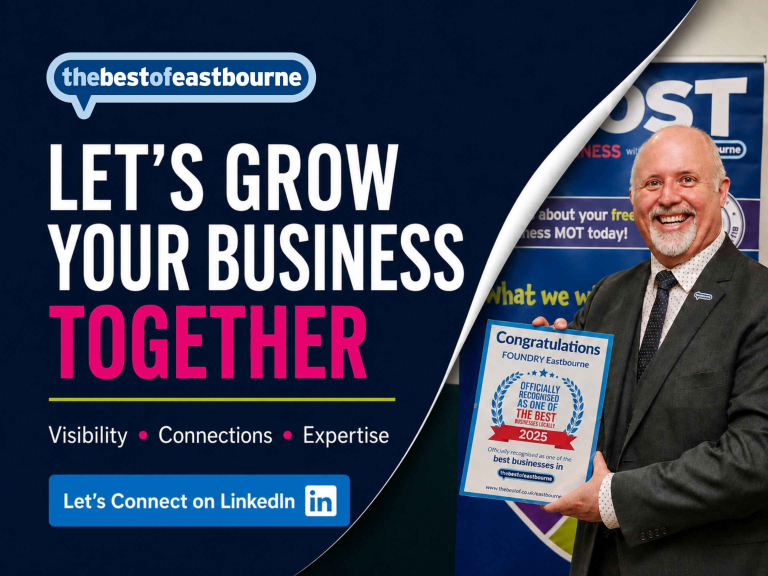
I've started sharing more of the networking lessons, observations and ideas I've picked up over the years on LinkedIn.
But networking works better as a conversation.
So if you connect with me, don't just send a connection request.
Tell me what you're working on, what problem you're trying to solve or what would be genuinely useful to you and your business.
I may know someone you should meet, have an idea worth trying or simply be able to point you in a useful direction.
Connect with me on LinkedIn and tell me: what can I help you with?
You don't need to be the loudest person in the room. You don't need to attend every networking meeting in Eastbourne. And you certainly don't need to come home with fifty business cards.
Find the rooms you enjoy being in.
Be interested in the people you meet. Look for opportunities to help. Follow up when there's a reason to. And give relationships enough time to develop.
The best result from your next networking meeting might not be meeting your next customer.
It might be meeting the person who eventually introduces you to them.