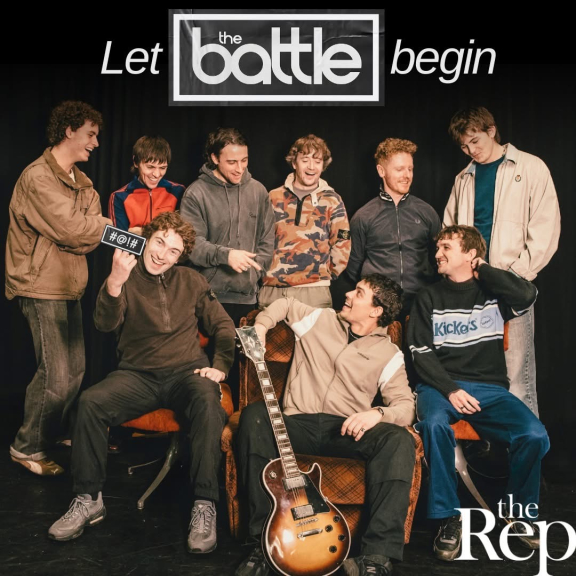
At the Birmingham Repertory Theatre, The Battle explodes like a Champagne Supernova as the bands clash onto the stage like a Britpop firework with a short fuse from the start To The End – you just gotta Roll With It. Enough already! Let’s begin ... stunningly directed by Matthew Dunster and written by John Niven, this rip-roaring theatrical riot dives headfirst into the 1995 chart war between Blur and Oasis - and trust me, you’ll want to hang on to your parkas and enjoy the ride. The so-called “battle” between Blur and Oasis isn’t really a war - it’s more of a perfectly balanced yin and yang that the whole Britpop spectacle ignites. The “battle” they sparked in the ‘90s wasn’t about destruction - it was about contrast. Thoughtfulness versus thunder. Smirk versus snarl. Tension made electric. Like any decent yin and yang, one defines the other. Blur’s clever cool feels cooler because Oasis are so gloriously loud. Oasis’ grand anthems feel grander because Blur are over there being brilliantly restrained.
The Battle as a play makes you think - so picking a side misses the point. The rivalry works because both energies exist. It’s not a clash - it’s balance. Two halves of the same Britpop coin, spinning wildly and making the whole scene more exciting than it ever would’ve been alone. Act one magnetically sets the scene and interplay of the bands’ rivalry and in band tensions followed by the roller coaster ride of two with unexpected twists and turns and spins bubbling to a shocking finale.
Blur brought the wit. Oasis brought the swagger.
Blur made you think. Oasis made you shout.
Blur smirked. Oasis sneered ... and they shared a girlfriend!
Yes, the play centres on that infamous race for the Number One spot - Cool Britannia’s very own musical cage fight - but what makes this production sing (and snarl) is its refusal to simply replay the hits. Instead, it cranks the amp up on the human story. This is Britpop stripped of its swaggering press headlines and laid bare in all its insecurity, ambition, ego, testosterone and unexpected tenderness.
Leading the cast is Gavin and Stacey’s Matthew Horne as Blur’s manager with Andy Ross as Alex James, and Brandon Bendall captures the louche charm and slightly bewildered posh-boy cool of the Blur bassist with delightful precision. Meanwhile, Oscar Lloyd’s Damon Albarn is all nervy intellect and Southern art-school intensity - a man acutely aware that this isn’t just about a single release, but about cultural territory. The portrayal of the Gallagher brothers was tremendous and in terms of casting they win my vote with 21-year-old George Usher’s Liam Gallagher - an absolute live wire. Usher doesn’t just perform Liam; he inhabits him. The Manc strut. The parka-clad defiance, oozing his self-proclaimed “Top of the Tree” attitude. The perpetual sense that he’s one eyebrow twitch away from a scrap or a spot of badger strangling. Fiercely proud, fiercely talented, and fiercely unwilling to concede an inch. The stage energy is electric—volatile, magnetic, and very, very funny. North versus South. Intellectual versus proudly working class. London polish versus Manchester grit
Dunster’s edgy fast-paced, punchy direction keeps the momentum taut and propulsive, while the set design moves swiftly between public spectacle and cosy domesticity. One moment we’re in the glare of the industry’s spotlight, awards ceremonies, glitzy bars - the next we’re peering into messy living rooms and backstage corners. It’s in these quieter spaces that the play truly resonates. The music industry isn’t just glamorous chaos—it’s raw, competitive, and painfully personal. The battle for the charts becomes a battle for validation, for identity, for proof that where you come from matters. But perhaps one of the evening’s most deliciously ironic moments comes with the Gallagher brothers’ “Mummy” phone call. The swagger evaporates, the spicy language vanishes, and suddenly these rock ’n’ roll titans are polite, almost angelic, complete with their ‘choir boy’ best phone voices. It’s comedy gold—and a sly reminder that beneath the bravado, they’re just a couple of Manchester lads ringing home.
Act One magnetically sets the scene, humming with the delicious tension between Blur and Oasis — a rivalry so dramatic it made 1995 feel like a national sport. The brilliant cast shine the writer and directors’ spotlight onto that glorious Britpop moment when chart positions mattered like Olympic medals and every guitar riff felt politically significant. The atmosphere hums with competitive tension, but what really gives it bite are the in-band fractures simmering beneath the bravado. Egos orbit. Side-eyes are practically choreographed. You can feel the creative genius and the creative sulking sharing the same dressing room. The atmosphere hums with competitive tension, but what really gives it bite are the in-band fractures simmering beneath the bravado. Egos orbit. Side-eyes are practically choreographed. You can feel the creative genius and the creative sulking sharing the same dressing room.
Then Act Two straps you into a Britpop roller coaster and politely forgets to check your seatbelt. The pace quickens, the alliances wobble, the swagger wavers, and just when you think you’ve predicted the next chord change - spin. Another turn. Another delicious twist. It’s a whirl of chart battles, backstage melodrama, and emotional crescendos that feel one tambourine shake away from glorious implosion.
And just as the dramsa threatens to spiral into full rock-and-roll apocalypse the finale swerves. Not into tragedy, not into triumph exactly - but into something wry, self-aware and wonderfully fiunny. The ending lands like a perfectly timed punchline after two acts of glorious posturing, reminding us that the "battle" was always part performance, part passion and part very British pantomine. And then - like a glitter cannon of nostalgia - comes the nod to the Battle of Britpop itself - Country House cheekily trotting past Roll with It to snag the number one spot is staged with just the right amount of wink. It’s less “triumph of the ages” and more British “well, that was awkward, wasn’t it?” Blur’s quirky tale of suburban excess winning over Oasis’ strutting anthem feels, in hindsight, like irony beating swagger in a very polite sprint.
As for the visuals – the Wonderwall of bold backdrop animations were pure genius – reflecting how the 1990s often did more than entertain - it became a playful, self-aware mirror of the decade’s music culture, cheekily weaving in nods to radio icons like Jo Whiley and Chris Evans, whose larger-than-life broadcasting styles helped define the Britpop era. Cartoon cameos and soundtracks frequently tipped their hats to the wry charisma of icons like Jarvis Cocker, capturing the ironic cool and social commentary that pulsed through the scene. This play fuses animation and music and script used as narrative fuel - jangly guitar riffs, swaggering anthems, and tongue-in-cheek script and lyrics driving stories packed with wildly unexpected and amusing plot twists. As the screen flickered with bold colours and sharp satire, it became a dynamic storytelling device within the play itself, offering an insightful yet mischievous window into the nineties that audiences instantly recognised and loved.
Niven’s script is razor-sharp, laced with irony and belly-laugh one-liners that have the audience howling. The language is unapologetically spicy, the humour biting and bold. Yet threaded through the insults and posturing are surprising glimpses of softness -particularly between Noel and Liam. Yes, rock star Liam is an angst-ridden pulsing teenage tantrum teetering on a full-blown Manc meltdown. Beneath the rivalry though, beneath the press-fuelled mythmaking, there are flashes of brotherhood and love. Fleeting, fragile, but real mingled with a gritty portrayal of the intentions behind that chart showdown gives the play its beating heart. This wasn’t just about shifting units. It was about cultural dominance. About whose Britain would define the decade. About pride - in roots, in class, in sound.
In blending sharp wit, iconic voices, and era-defining sounds, this play becomes a time capsule and a mischievous wink at the cultural heartbeat of the nineties and its abiding relevance. A rip-roaring ride that proves Britpop’s greatest clash wasn’t just fought in the charts - but in hearts, homes, and the messy humanity behind the music. And somehow, British music won either way.
By the final curtain, The Battle feels less like a nostalgic jukebox trip and more like a visceral, grounding journey through ego, loyalty, and the intoxicating rush of ambition. It’s loud. It’s funny. It’s tender when you least expect it. It’s full of madness, celebration, and bravado delivered with the kind of swagger that would make both bands begrudgingly nod in approval.
I left feeling happier as I leave because in the end, the “musical war games” gave us anthems, headlines, and haircuts - but it also gave us perspective. The play leaves you basking in 1995 nostalgia, grinning at the absurdity of it all, and secretly thrilled that for one brief, glorious week, a song about a posh man in a very big house managed to shake the kingdom. It’s sharp. It’s kinetic. It’s a little bit chaotic. And like the rivalry itself, it leaves you grinning - and maybe humming Parklife on the way out.
So - my official position? I’m Switzerland wrapped in a parka with an Aldous Huxley novel in my pocket shaking a tambourine. You can love both – I do - the brains and the bravado. After all, life’s too short so Don’t Look back in Anger you can have sarcastic art-pop on Monday and stadium-sized singalongs on Friday.
Now if you’ll excuse me, I’m heading for The Great Escape to the VIP bar for a bevvy, I’ll be over here making a playlist called “Can’t We All Just Get Along (But Loudly)”. I may even pen a poem about it “know what I mean?” LGx.
By Serena Fiero Poet, Writer and reviewer