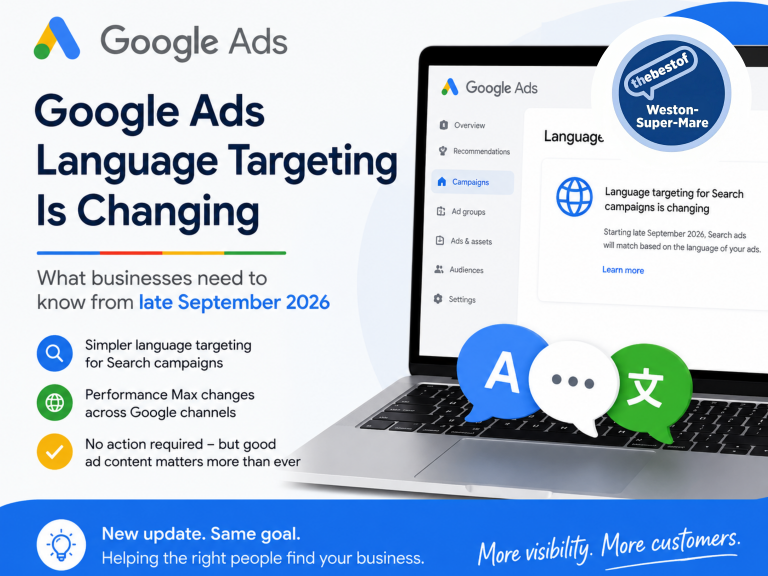
Google Ads Is Changing Language Targeting – Here’s What Businesses Need to Know
Google is making another change to the way its advertising platform works, and this time it concerns language targeting in Google Search and Performance Max campaigns. The update is due to take effect from late September 2026, and although it may sound quite technical, the basic idea is actually fairly straightforward: Google wants to use more automation to match adverts with people who are likely to understand them. For most businesses, there is no immediate action required, but it is worth understanding what is changing and how it could affect future Google Ads campaigns.
So, what is changing?
At the moment, advertisers can select the languages they want to target when setting up certain Google Ads campaigns. For example, a UK business may choose English as its target language because that is the language used in its adverts and on its website. From late September 2026, Google says it will remove the campaign-level language targeting setting from Search campaigns. Instead, Google Search will increasingly use the language of the advert itself, together with other signals, to decide whether that advert is suitable for the person carrying out the search.
Google already uses a number of signals to understand which languages somebody may understand, including their searches, settings and other activity. In simple terms, Google is becoming less reliant on advertisers ticking a box saying “show this to English-speaking people” and more reliant on its own technology to work out whether someone is likely to understand the advert.
What about Performance Max?
Performance Max campaigns are slightly different because they can place advertising across several Google services, including Search, YouTube, Gmail, Discover and the Display Network. For Performance Max adverts appearing in Google Search, language matching will work in much the same way as standard Search campaigns, with the language of the advert becoming more important.
However, on other Google channels such as YouTube, Display, Discover and Gmail, the campaign's selected language will still be used as a guide when deciding who may see the advert. Google's Performance Max platform already relies heavily on AI and machine learning to determine which customers are most likely to respond to an advert, using information from the campaign, website and other signals rather than relying entirely on manually selected keywords and settings.
Why is Google making the change?
This is another example of Google moving towards greater automation and AI within its advertising platform. Rather than expecting advertisers to manually control every individual setting, Google's systems are increasingly analysing search behaviour, language, advertising content and other signals to determine which advert is most relevant. For businesses, that can potentially make campaigns easier to manage. But it also makes one thing particularly important:
The quality and clarity of your adverts matter more than ever. If Google is using the language and content of an advert to help understand who it should be shown to, businesses need to make sure their advertising copy clearly explains what they offer, who it is for and why somebody should choose them.
Will businesses need to change their Google Ads campaigns? According to Google's announcement, no immediate action is required. Businesses may continue to see the existing language setting inside Google Ads while the update is being rolled out, so don't be surprised if it doesn't disappear immediately.
However, it is still sensible to review your advertising from time to time. Check that your advert copy is written naturally, that it accurately represents your business and that it leads people to a useful and relevant page on your website. It is also worth monitoring campaign results following any major Google Ads update. Automation can be extremely useful, but businesses should still keep an eye on where their advertising budget is going and whether it is producing the enquiries, sales or website visits they actually want.
Less button-clicking, but good content matters more
The bigger picture is fairly clear.
Google continues to move away from advertisers manually controlling every aspect of a campaign and towards systems that use AI to understand what somebody is looking for, what an advert is offering and whether the two are a good match. For many small businesses, that may ultimately make Google Ads simpler. But simpler campaign settings don't mean businesses can forget about their marketing. If anything, creating clear adverts, useful website content and a strong online presence is becoming even more important. The technology behind Google may keep changing, but the principle remains reassuringly familiar:
Make it easy for people – and Google – to understand what your business does, who you help and why you're worth choosing.
And, of course, keeping up with Google, online marketing, content and all the changes that seem to come with them can sometimes feel like another job in itself. If you’d like a hand making sure your business is being seen by the right people, thebestof is here to help. From creating regular, relevant content to strengthening your online presence and helping more local customers discover your business, have a chat with us and see how we could support your marketing.


